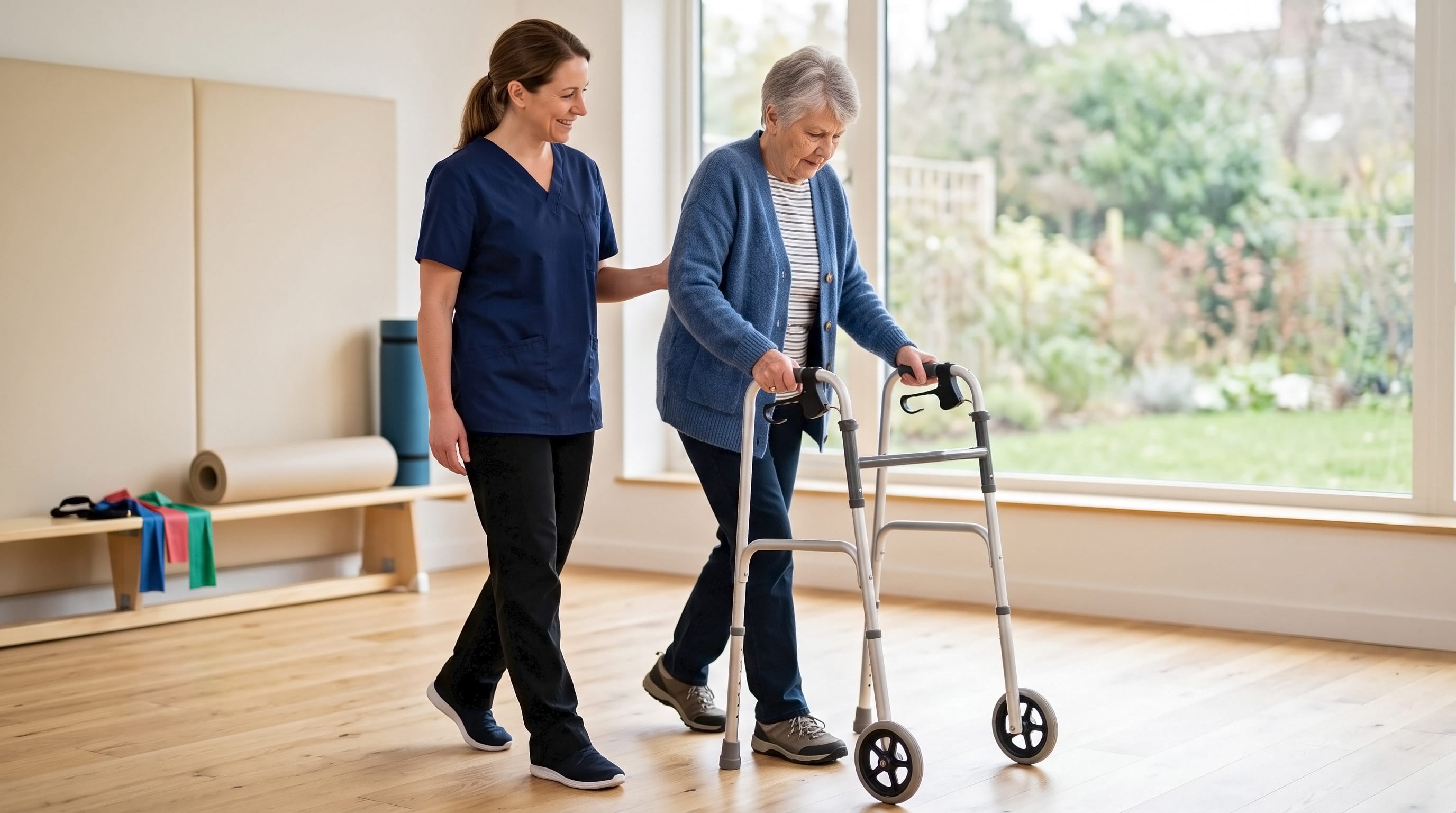
Hello, we are Amory Peer and Michael Anderson, two of the physiotherapists here at the Horder Centre, part of Horder Healthcare. This video is designed as a reference tool for anybody that has had knee replacement surgery here at the Horder Centre. We appreciate that there is a great deal of information to take on board pre and post operatively and we want to give you as much help as possible to ensure you don't feel alone between hospital discharge and your follow-up with your consultant. This video may also be useful for people that have had surgery with other providers, but it is important that you check with your own therapy team if you have any concerns about what you should or should not be doing. This video is designed to answer some of your questions and reassure you with regards to your progress. The video is designed for patients who are discharged with two walking sticks and have no special post operative instructions. However, it is still important for you to contact us if you have any concerns about your progress. We think it is important to stress some things that are quite normal at this stage of your rehab. Firstly, pain is quite normal, especially when doing your exercises. The exercises aren't designed to be easy and they're designed to increase the range of movement in your knee and maximize the potential of your knee replacement surgery. It is quite normal to experience pain at night and this can be for a number of weeks, generally because the knee is kept in one position for a length of time. Continue to take your pain relief as it was prescribed from the Horder Centre when you left us. It is important to manage your pain relief, as it helps you maximise the potential of your knee replacement surgery, and also manage your exercises on a daily basis. If you have any concerns about your pain relief, please contact your GP. Swelling after a knee replacement is very normal. It often occurs for a number of weeks, and can be quite debilitating. It's important that you manage your swelling on a daily basis, not just in the early stages of your rehabilitation. It's important that you elevate your leg for various periods of the day, but we accept that this isn't always practical. While you elevate the leg, preferably above hip or heart height, apply an ice pack to the knee for approximately ten to fifteen minutes. It isn't dangerous to leave on for any longer, but the effects of the ice tend to wear off after this length of time. Once the wound is fully healed and you have had your check from your local nurse, you're able to rub in anti inflammatory cream or gels around the wounds and into the knee. If you have any concerns about using this type of product, please contact your GP or pharmacist accordingly. As your knee exercises become more difficult and more challenging, the knee may also continue to swell. It is important that you manage the swelling effectively throughout the day by elevating your leg and also applying ice packs for ten to fifteen minutes at a time. Let me introduce John, a patient at Horder Healthcare who has recently undergone knee replacement surgery four months ago. The first set of exercises that we are going to focus on are flexion exercises. In simple terms, the amount that you can bend your knee. The flexion exercises are vital in the early stages to stop the knees stiffening up due to scar tissue formation. We would like you to achieve at least ninety degrees of knee flexion by the time you come back to see your consultant following discharge from hospital. Now in simple terms ninety degrees is a right angle or being able to sit in a standard chair with your knees bent comfortably and your feet beneath your knees. It is vital that you complete the flexion exercises little and often throughout the day. The first exercise we are going to talk about is the lunge. Now this can be done on a step or a low stool, preferably with some support for your hand if you need it. Place your operated leg up on the step and lean forwards, allowing your knee to bend. As you push into it, your knee will bend further. There are two options here either to move backwards and forwards bending the knee through range. The idea of this is to mobilise the joint and lubricate it. The second option is to hold the knee in a bent position to allow the soft tissues around the knee to stretch. It is normal to feel some stretch and discomfort in the knee. This isn't going to be a very nice exercise. If you are moving the knee backwards and forwards, there is no exact number of repetitions to use, but we would recommend maybe eight to twelve repetitions and two or three sets. And again, the idea is to mobilise the joint. If you are holding the knee in a bent position, the stretch should last for at least thirty seconds, leading up to about a minute if you can. With this exercise, it is important to repeat little and often throughout the day to keep the joint moving. The next exercise we're going to look at is called seated knee flexion, so bending your knee while you're sitting in a chair. Position yourself in a chair with your knee bent and your foot on top of something that will slide on the floor. A carrier bag works quite well. Slide your foot backwards and forwards. Lovely. As you can see John is keeping his hips nice and still on the chair and he's not lifting up. Okay? He's moving into a range that's comfortable for his knee. If you feel like your knee needs a bit more of a push, place the other foot on top of the operated leg and push back into a stretch. Thank you John. There are two options here either to move the foot steadily backwards and forwards as John just demonstrated or to hold the foot in a bent position. If you are simply moving the foot backwards and forwards we would suggest aiming for about ten repetitions and doing this little and often throughout the day. If you are holding the knee in a bent position, we would recommend that you hold for at least thirty seconds, and this will allow the soft tissues around the knee to stretch and relax. Again, for stretches, it is important that this is repeated little and often throughout the day. The next exercise we will focus on is seated knee flexion using body weight. Position yourself in a chair with your knees bent and your feet on the floor. Slide your operated leg back as far as you can go and then move your body weight forwards by sliding your bottom forward in the chair. Feel the stretch and discomfort in your knee. It may help to massage the painful part of the knee to help the muscles relax. With this exercise as it is a stretch we recommend that you hold in position for at least thirty seconds to enable the muscles to get used to this new length and position. As with the previous exercise it is recommended that this is performed little and often throughout the day. The next set of exercises are designed to help you achieve full extension of the knee. In basic terms this means a fully straight knee. The next exercise is inner range quadriceps in sitting. For this exercise you will need the following pieces of equipment. A cylindrical object or a firm object to place underneath the knee. Today we are using a tube, but a two liter bottle of soft drinks is a good alternative. Using the towel, wrap it around the tube, And John, if I can ask you to place that underneath the back of your operated leg. Brilliant. In this position, what we going to ask John to do is to point his toes up towards him and lift the leg up off the bed keeping the back of the knee onto the tube. We recommend that you hold this for five seconds and repeat at least ten times. It's ideal that you repeat two to three sets of this exercise. When performing this exercise, it's ideal to feel the muscles at the front of the leg working and to repeat these exercises little and often throughout the day. And relax. And that's good. The next exercise is passive knee extension with self massage. Using the same equipment for the previous exercise, using a cylindrical object and also a towel, wrap the cylindrical object in the towel, and John if I can ask you to place that underneath the ankle of the operated leg. In this position, ideally we just want you to relax. To help you relax, try and massage around the knee both at front and underneath. This will help relax the muscles and allow the knee to flatten and straighten a little bit more. This initially is quite a painful exercise. Try and do it for as long as you can tolerate and ideally know for no longer than about three to four minutes at a time. Again, like all of the exercises today, repeat these listen often throughout the day. The next exercise is hamstring stretch in standing. This basically means increasing some flexibility and stretching out the muscles at the back of your thigh. Ideally, using the bottom of your staircase at home if you have stairs or a step. Hold on to a support if you can, as this will help with your balance. In this position here, John, if we can get you to step your operated leg up onto the first step onto the heel. In this position here, bringing your toes up towards you to achieve as straight a leg as you can. In this position, John, if you can start to keep a nice back position, lean your body slightly forward, sticking your bottom out behind you, and bending the unoperated leg slightly. You should be feeling a stretch at the back of your thigh at this moment. Ideally, we'd ask you to hold this for twenty to thirty seconds, and repeat two to three times. And like all the other exercises, repeat little and often throughout the day. And relax there and take the foot down. And that's brilliant. The next group of exercises that we will focus on are aiming to improve the strength of your knee. The first of the strengthening exercises is called sit to stand and in reverse stand to sit. Find yourself a good height chair preferably with arms. Okay, John what I would like you to do is to stand up nice and slowly using minimal support from your arms. The slower you stand up the harder the movement will be and the more your muscles will work. In reverse, John can reach back for the arms of the chair and lower himself down. Again, if you lower more slowly, the muscles will have to work harder. We're aiming to keep your feet equal so they have to do the equal amount of work. This exercise can be made easier by increasing the height of the chair so perhaps using cushions making sure they won't fall off and using more support from your arms. It can be made more challenging by using less or no support from your arms as will be demonstrated by John. And the same sitting down again. Good. If you would like to do a set number of repetitions for this exercise, we would recommend between eight and twelve to strengthen the muscles. However, it will be more valuable to you if you incorporate it into your daily routine and think about these principles every time you stand or sit. We're now going to talk about the stairs. They provide an excellent platform to build up the strength in your knee, both on the way up and on the way down. The next stage of your rehabilitation is to change the way that you go up and down the stairs, and we want to build on the strength of your operated leg. When you're in hospital, you are taught to do the stairs one at a time with your good leg leading up and your bad leg leading down. And again, John, just another step. Thank you. John, if you turn around nice and carefully, you can just demonstrate the way down. Excellent. If you have small steps at home, this is a good place to start. But if not, a telephone directory or a thick book in a stable position is a good alternative. You can attempt, as long as you feel comfortable, to swap it round. Okay? So therefore, leading up with the bad leg and down with the good leg. And John's just gonna demonstrate a couple of steps like that. John, if you turn around nice and carefully for me. So your good leg comes down. Good. And down. Excellent. And turn around for me. Now it's a good idea to start with just two or three repetitions of this because your legs aren't gonna be used to it. But you can increase that up to maybe ten or more repetitions to replicate a full flight of stairs. Again, little and often throughout the day is best, and think about these principles every time you go up and down the stairs when you get a bit more confident. Ultimately, we would like you to do the stairs one after the other, how we call reciprocally. And we would like you to be just starting this by the time you come back to see your consultant. John, if you would like to demonstrate reciprocal stairs. And then if you turn around. Excellent. Finally it is important to start balancing on your leg as soon as you can. While doing this exercise it is important to use a support like John here using the back of a chair or using your mobility aids that you were discharged with from hospital. In this position, John if you can start to just transfer your weight from one leg to the other. Nice and slowly. This will help to increase a bit of weight bearing through the operated leg and increase a bit of the muscle activation as well. Once you feel confident in the strength and the ability of your operated leg, you can start to practice balancing on one leg. Doing this, like John, using a support like a chair, lift the unoperated leg up, putting your weight fully through the operated leg. This can be made more difficult by increasing the amount of time that you're standing on one leg for also reducing the amount of support, for example taking one hand away from the chair. Always be safe when practicing these exercises, as we don't want you to fall. Try practicing this little and often throughout the day. Ideally hold for no longer than thirty seconds to one minute. Once you've been discharged by your consultant, it is still important that you exercise your knee regularly. Here at the Horder Centre, we provide a range of supported, structured exercise class that help to maximise your knee replacement and also increase your general health and well-being. We hope that you have found this video useful and that it has given you some more ideas on ways that you can improve your knee. Should you have any further queries or concerns, it is important that you contact the physio team that has been treating you.